
Guide
How much deposit should you take for an event booking
Choose an event-booking deposit amount, set due dates and refund terms, and track paid versus owed without relying on bank statements.
A deposit is not really about the money. It is about turning "we're interested" into a date that is actually held. Get the amount, timing, and record-keeping right and the rest of the booking is calm. Get it wrong and you spend the weeks before the event chasing balances and arguing about what was agreed.
How much deposit should you take?
Enough that walking away costs the client something real, not so much that it feels like paying for the whole event up front. For most event businesses that lands somewhere between a fifth and a third of the total. Below that, a deposit barely changes anyone's behaviour — it is easy money to forfeit. Much above that, you are asking someone to fund your business before they have seen a single deliverable, which is a harder sell and not always a fair one.
The number should also cover your actual exposure: if a client cancels two weeks out, what have you already spent or already turned away? Travel booked, a second shooter confirmed, another enquiry declined because the date was held. The deposit should at minimum cover that.
When should the deposit be due?
Before the date is held, not after. A verbal or emailed "yes" is not a booking — it is an enquiry that has not been backed by anything. The date should stay open to other enquiries until the deposit lands. This is the single most common gap in informal booking processes: two clients both think they have the date because both got a friendly reply.
What makes a deposit non-refundable in practice?
A sentence in an email is weak protection. "Non-refundable" only holds up if it is written into an agreement the client actively agreed to — a contract or signed terms, not a policy mentioned in passing. Gallurio does not generate contracts or collect e-signatures, so that agreement has to live somewhere else: a contract tool, a signed PDF, even a clause in a booking confirmation the client replies to in writing. Whatever you use, the non-refundable term needs to exist in a form you can point to later, not just in your own memory of the conversation.
How do you track what is paid against what is owed?
With a running total per booking, not a mental note. The minimum you need per booking:
| Field | Why it matters |
|---|---|
| Total price | What the booking is worth |
| Deposit due date | When the date-hold expires if unpaid |
| Amount paid so far | What has actually landed, not what was promised |
| Balance owed | Total minus paid — the number you chase |
| Balance due date | Usually before or on the event date |
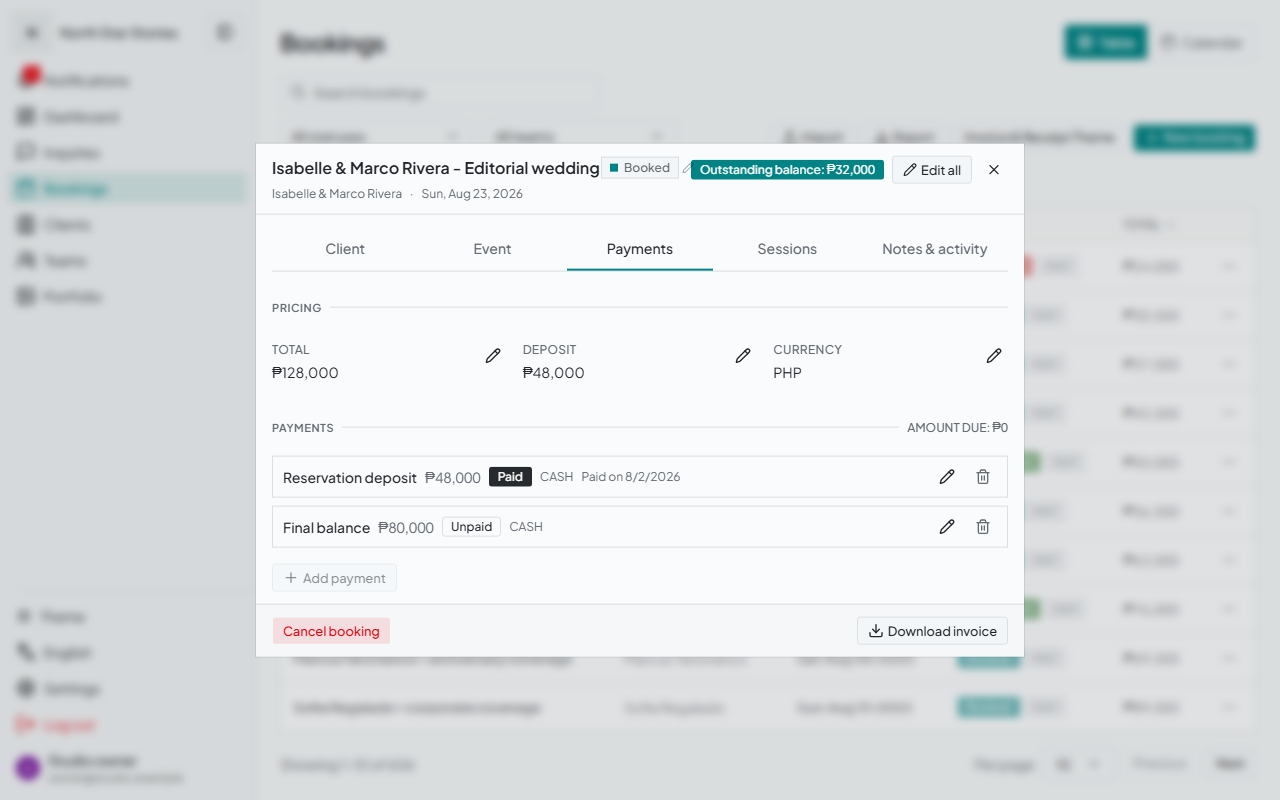
The moment this lives in more than one place — a notebook, a spreadsheet, memory — it drifts. Someone pays partially, the note doesn't get updated, and three weeks later nobody is sure if the balance is half paid or fully paid.
What goes wrong when deposits live only in a bank statement?
A bank statement tells you money arrived. It does not tell you which booking it belongs to, whether it was the deposit or a balance payment, or what is still owed. Multiply that across a full season of bookings and the statement becomes a puzzle you have to solve every time someone asks "did I pay already?" — which is usually the client asking, not you noticing first.
The fix is not a fancier bank account. It is recording each payment against the specific booking the moment it happens, so the paid/owed number is always current without anyone reconstructing it from transaction history.
What most people get wrong
- Treating the deposit as optional for people they trust. The point of a deposit is to hold the date against everyone, including friendly, reliable-seeming clients. It is not a judgment of character.
- Not writing down when the balance is due. "Before the event" is not a date. Pick one and put it somewhere both sides can see it.
- Assuming a chat message counts as a record. It is easy to lose in a thread. A booking's financial state should not depend on scrolling back through messages.
- Confusing "invoiced" with "paid." Sending an invoice is not the same as receiving the money. Track the actual payment, not the request for it.
What should your public page say about deposits?
Enough to prevent surprise, but not a wall of legal language. If the date is only held after a deposit, say that near the package or inquiry action. If the amount varies, explain the rule rather than publishing a number that will be wrong for half your work. Keep the full cancellation and refund terms in the agreement the client actually accepts.
This also improves the quality of enquiries arriving from search. A potential client who can see the starting price, deposit expectation, service, and location can decide whether the fit is real before contacting you. Search visibility is more valuable when the page qualifies the visitor instead of merely collecting a click.
Gallurio does not process card payments or collect them for you — you still take the payment however you already do. What it does is let you log that a payment happened against a specific booking, so the paid and owed figures stay attached to the booking instead of scattered across a bank app. Whatever tool you use, the principle holds: a deposit only works as a system if paid-versus-owed is recorded per booking, not reconstructed later from a statement.
Related reading
- Client onboarding checklist for event businesses — where the deposit request fits in the sequence after a client says yes
- Gallurio vs Google Sheets — why a shared spreadsheet stops keeping up with payment tracking
- How to price your event photography packages — setting the total the deposit is a percentage of
- How to build a portfolio page that gets found and books clients — presenting prices, proof, and the next step clearly