
Guide
How to price your event photography packages
Price event photography packages using cost floor, target income, and market checks, then choose a package structure and present it clearly.
Most photographers price by looking at what the person down the road charges and shaving 10% off it. That is not pricing. That is guessing with extra steps, and it is why so many working photographers are busy and broke at the same time.
Here is a method that starts from your numbers instead.
What should a photography package cost?
Work it out in three passes, in this order. The first gives you a floor, the second gives you a target, the third tells you whether the market will bear it.
1. Find your cost floor
Add up what a single booking actually costs you to deliver:
- Direct costs — travel, parking, second shooter, prints, album, gallery hosting, any props or rentals.
- Time, at a real hourly rate. Not just the shoot. Enquiry emails, the consultation, the contract, travel time, culling, editing, delivery, the follow-up. For a wedding this is routinely three to four times the hours on the day.
- A share of your annual overheads — gear depreciation, insurance, software, website, marketing, accounting. Total them for the year, divide by the number of bookings you realistically take.
That sum is your floor. Below it you are paying for the privilege of working.
2. Set your target income
Decide what you need to earn in a year, after tax. Divide by the number of bookings you can take without burning out — and be honest, because that number is smaller than you think. A wedding photographer shooting every weekend in season is not doing 52 weddings; between editing, admin and being a person, 20 to 30 is a full year.
Target income ÷ realistic bookings = what each booking needs to contribute. Add the cost floor. That is your price.
3. Check it against the market
Now look at what others charge — but as a sanity check, not a starting point. If your number is far above the local range, you need a reason a client can see: a distinctive style, a stronger portfolio, faster delivery, something. If it is far below, you have probably undercounted your hours.
The three package structures that work
Good–better–best (three tiers). The most common structure, and it works because it changes the question from "should I book?" to "which one?". Make the middle tier the one you actually want to sell — most people take it.
One package plus add-ons. Simpler to explain and easier to keep straight. Good if your work is consistent and the variables are extras: a second shooter, an album, an extra hour.
Hourly plus deliverables. Suits corporate and event work where the length genuinely varies. Weak for weddings, where clients want to know the total, not a rate.
What most people get wrong
- Pricing the shoot, not the job. The eight hours on the day are a fraction of the work. If your price only covers the shoot, every booking loses money on the editing.
- Never raising prices. Costs go up every year. If your prices have not moved in three years, you have taken a real-terms pay cut three times.
- Discounting instead of restructuring. A discount says your first number was not real. If someone cannot afford a package, take something out of it — fewer hours, no album — so the price drops for a reason.
- Hiding the price entirely. "Enquire for pricing" filters out serious buyers along with the tyre-kickers. A starting-from figure on your public page saves everyone a week of email.
- Forgetting tax. Set aside the tax portion the day the deposit lands, not in the following April.
How to present prices publicly
Put a starting price on your public page. Not the full menu — a floor, so people can self-select. Something like "Wedding coverage from ₱45,000" does more filtering work than three paragraphs about your approach.
Then make the enquiry easy. Every extra step between "I like this" and "I have contacted them" costs you bookings, and a contact form that just sends an email means you are the system that turns an enquiry into a booking.
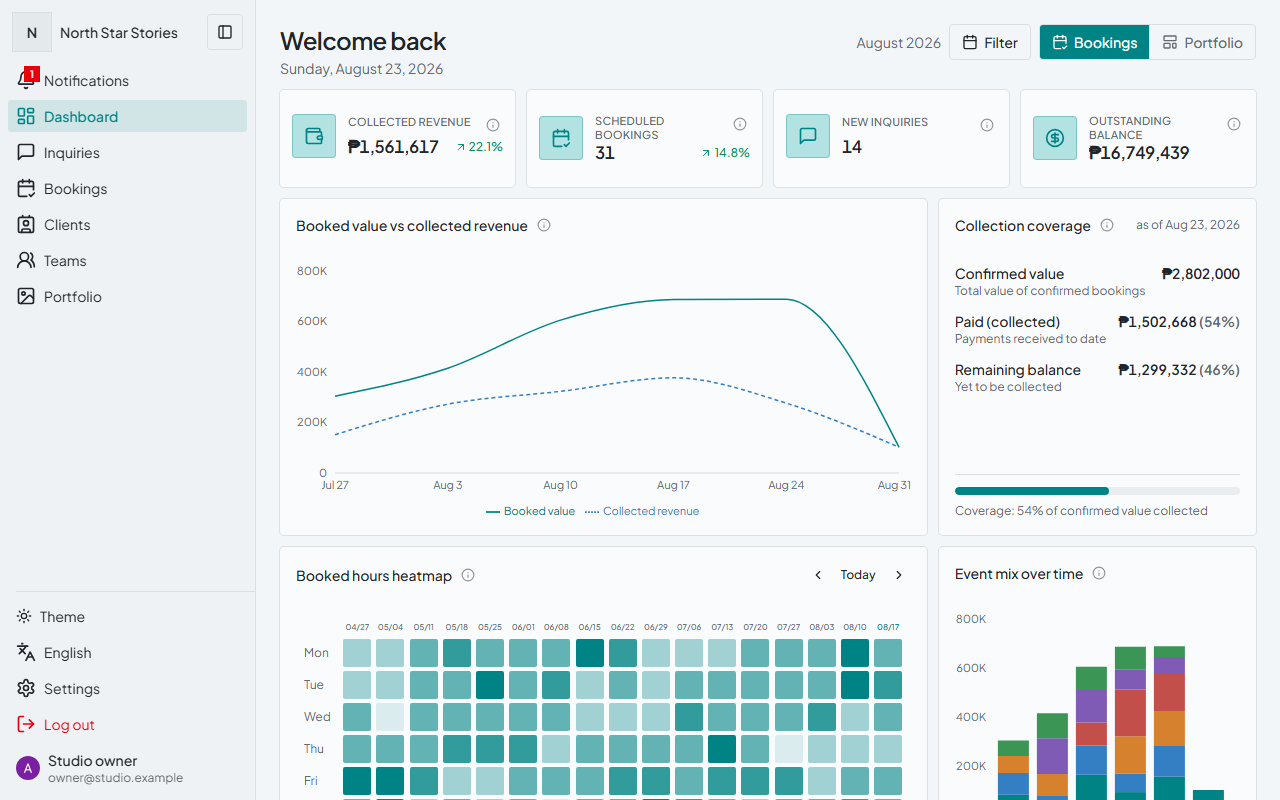
In Gallurio, a public portfolio can carry your packages and a contact form, and a submission creates the client record and the booking together — $15.00/mo — $150/yr. Owners can also configure the published page's search title and description, a separate Gallery description, canonical URL, social preview image, and indexing preference. Those settings help crawlers understand what the business offers; they do not make a weak or generic package page rank by themselves. Whether you use it or not, the principle stands: the shorter the path from interested to booked, the more of them book.
Can a package page help potential clients find you?
Yes, when it answers a specific search better than a generic price list. Someone searching for "event photographer packages in Cebu" or "Dubai corporate photography prices" is giving you the service, location, and decision they are trying to make. Use those details naturally in the page heading, introduction, package names, and supporting copy, then show relevant work beside them.
The technical SEO layer still matters: a descriptive page title, a useful search-result summary, a stable canonical URL, fast mobile delivery, and crawlable text all make the page easier to understand. But search visibility is earned by the usefulness and specificity of the page. Google's SEO Starter Guide describes SEO as helping search engines understand content and helping people decide whether to visit — not as a guarantee of first place.
Related reading
- Gallurio vs Google Forms and email — what happens after someone fills in your enquiry form
- Gallurio vs Google Sheets — when the spreadsheet stops keeping up
- How to build a portfolio page that gets found and books clients — connecting package copy, proof, and search intent