
Comparison
Gallurio vs Google Sheets for event bookings
Gallurio is a Google Sheets alternative with portfolio SEO, public inquiries, structured bookings, client history, team roles, calendars, and invoice PDFs.
Start with Gallurio if
Teams that need a public project showcase, reliable invoices, client history, roles, and an inquiry-to-booking workflow
Consider Google Sheets if
Solo businesses with a small booking volume and a process that still fits comfortably in one sheet
The short version
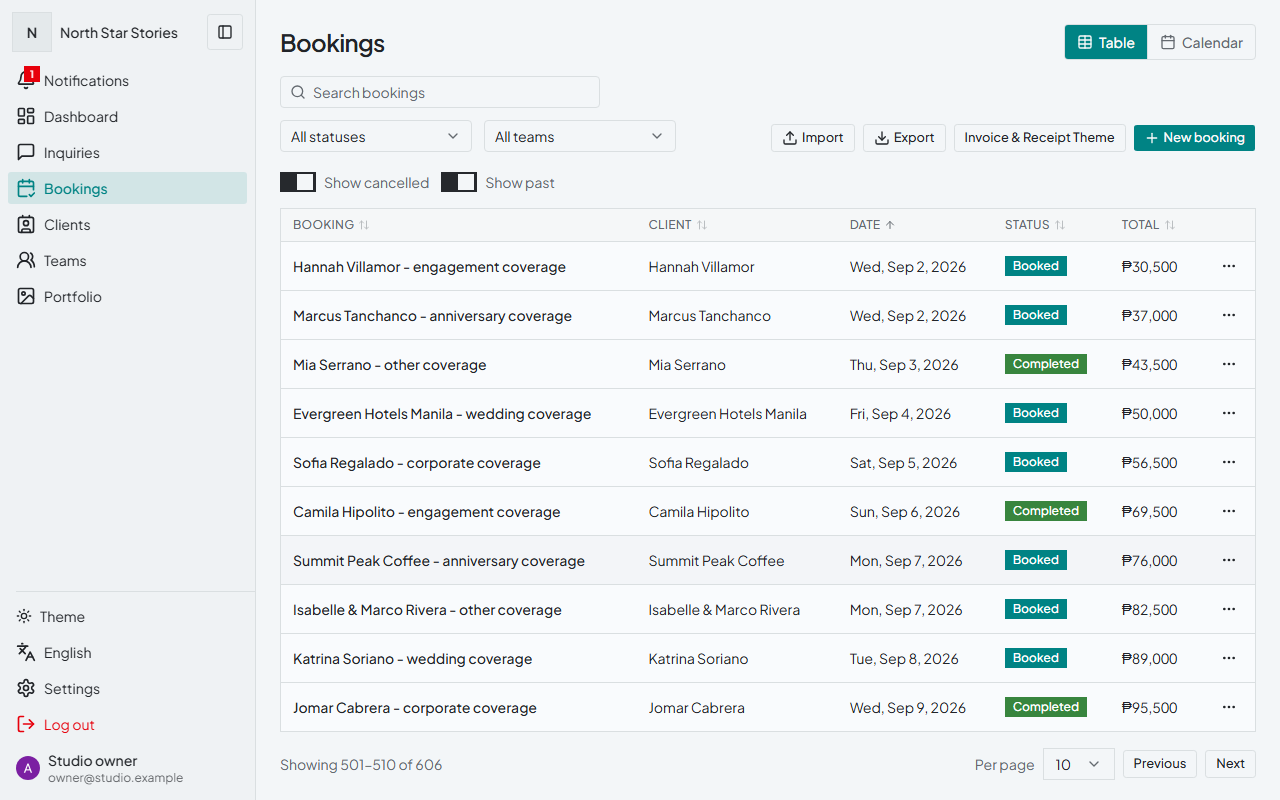
Start with Gallurio when bookings need dependable client history, team access, a calendar, and invoice PDFs instead of a sheet that only stays correct through manual discipline.
Most event businesses start in a spreadsheet, and that is the correct decision. It is free, everyone knows how it works, and for the first twenty bookings it does the job.
It stops working at a predictable point, and the point is not "when you get big." It is when these three overlap:
- You need to send invoices. A spreadsheet holds the numbers. It does not produce a branded PDF with line items, and copying figures by hand is where mistakes get expensive.
- Someone else needs to edit it. Two people in one sheet is fine. Two people plus a formula plus a filter view is how a column gets sorted independently of its neighbours and a whole row of data silently belongs to the wrong client.
- You need history. What did this client book in 2024, and what did they pay? A spreadsheet can answer that only if you never restructured it.
Gallurio is $15.00/mo — $150/yr, which is the entire argument. It is not free, and it is close enough to free that the comparison is about your time rather than your budget.
Price
| Gallurio | Google Sheets | |
|---|---|---|
| Cost | $15.00/mo | Free |
| Invoicing | Branded PDFs from a booking | Manual, or a separate tool |
| Public enquiry form | Included, writes to your data | Google Forms, exports a row |
| Multi-user safety | Roles, per-workspace scoping | Anyone with the link can break anything |
| Client history | Kept automatically | However you structured it |
What a spreadsheet does that Gallurio does not
Being fair to the incumbent:
- It costs nothing.
- It does anything. Any column, any formula, any layout, changed in seconds.
- Everyone already knows it. No one needs training.
- It exports and shares trivially, and every accountant on earth accepts it.
- It works offline and will still open in ten years.
What Gallurio does that a spreadsheet does not
- Generates invoice PDFs from a booking, with your branding.
- Publishes a creative storefront with configurable Home and Gallery canvases for services, featured projects, imagery, video, and gallery collections, plus the Contact experience.
- Turns an enquiry into a client and a booking in one step, with no re-typing.
- Keeps client history automatically, including what they paid.
- Shows a real dashboard — revenue over time, upcoming bookings, top clients — without you building the formulas.
- Enforces structure, so a booking cannot exist without a client and a row cannot be sorted into the wrong place.
From a private sheet to a discoverable storefront
A spreadsheet begins after you already have the lead. It does not explain the service, show a body of work, or give search systems a public business page to understand. Gallurio connects that missing front door to the structured records behind it.
Published portfolios are server-rendered and support configurable Home and Gallery search copy, canonical URLs, social previews, structured business/gallery data, and an indexing choice. Those features can make a real service and project portfolio eligible for discovery; they cannot promise that Google or an AI answer will select it. The visible work, location, expertise, and links still matter.
Who this is not for
Stay in the spreadsheet if:
- You take a handful of bookings a year.
- You invoice through your accountant and never touch it yourself.
- You are the only person who will ever open the file.
- Your process genuinely needs columns nobody else's business would have.
Related comparisons
- Gallurio vs Notion — the structured version of the same instinct
- Gallurio vs Google Forms and email — the intake side
- Gallurio vs HoneyBook — where you land if you keep scaling
Sources
Google Sheets is available with a Google account; Google Workspace plans add business administration and collaboration features without changing the core comparison above. Verified 2026-08-23.
Frequently asked questions
What is wrong with running my bookings in a spreadsheet?
Nothing, until three things happen at once — you need to invoice, a second person needs to edit it, and you need to know what a client booked two years ago. A spreadsheet handles each of those badly and all three together not at all.
Is Gallurio worth paying for when Sheets is free?
That depends entirely on volume. Under roughly one booking a month, probably not. Once you are invoicing regularly and answering enquiries from a public page, compare Gallurio's current regional price with the time the spreadsheet costs you.
Can I import my spreadsheet into Gallurio?
There is no importer today. Existing bookings and clients would be entered through the app. For most businesses moving off a spreadsheet, that is a one-time evening.
Does Gallurio give me the flexibility of a spreadsheet?
No, and that is deliberate. A spreadsheet lets you put anything in any cell. Gallurio does not, which is the reason its data stays consistent and the reason it can generate an invoice from a booking.
Can a spreadsheet help potential clients discover my business?
A sheet can be shared, but it is not a creative portfolio. Gallurio publishes server-rendered Home and Gallery pages with configurable search descriptions, canonical URLs, social previews, structured business/gallery data, and an indexing preference. No platform can guarantee indexing or rankings.