
Comparison
Gallurio vs Google Forms and email for inquiries
Gallurio is a Google Forms alternative combining portfolio SEO, public inquiries, clients, event bookings, calendars, and invoice-ready records.
Start with Gallurio if
Creative teams that want a real project storefront and cannot keep losing inquiries between a form, inbox, spreadsheet, and calendar
Consider Google Forms and email if
Low-volume businesses that need completely custom forms and can maintain the handoff themselves
The short version
Start with Gallurio if you want every public inquiry to become a tracked client and booking without copying data between a form, an inbox, a spreadsheet, and a calendar.
The most widely used booking system in the event industry is not HoneyBook or Dubsado. It is a Google Form, a Gmail inbox, and a spreadsheet. It is free, it is understood by everyone, and for a lot of businesses it works.
It leaks in one specific place: the handoff. The form produces a row and an email. Neither of those is a booking. A person has to read the email, decide it is real, copy the details into the spreadsheet, add it to a calendar, and remember to reply. Every one of those steps is a place an enquiry stops.
Gallurio removes the handoff. The public form writes the inquiry, the client and the booking in a single transaction — either all three exist or none do. It is $15.00/mo — $150/yr.
What the flow looks like
With Google Forms and email
- Visitor submits the form.
- A row appears in a spreadsheet.
- An email arrives in an inbox that also contains everything else.
- Someone reads it, eventually.
- Someone copies the details into the bookings sheet.
- Someone adds it to a calendar.
- Someone replies.
Steps 4 through 7 are manual, and each is optional in practice.
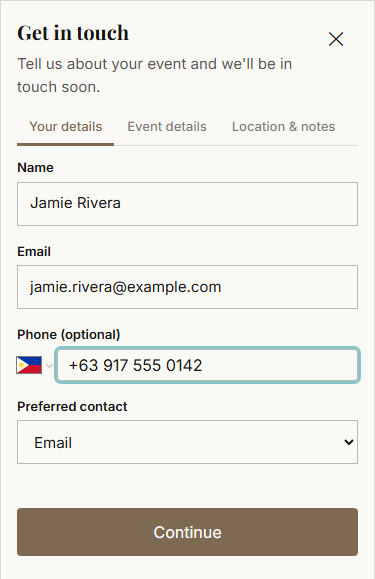
With Gallurio
- Visitor submits the form on your portfolio page.
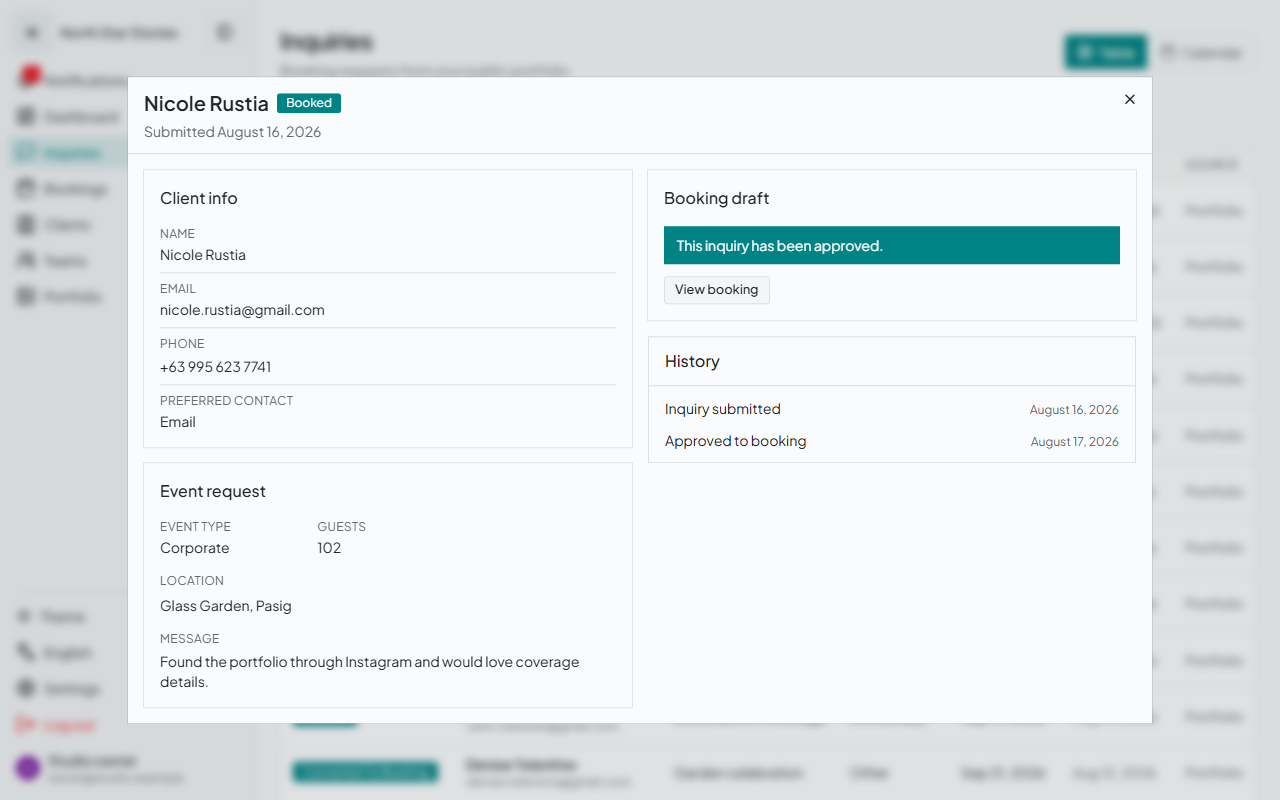
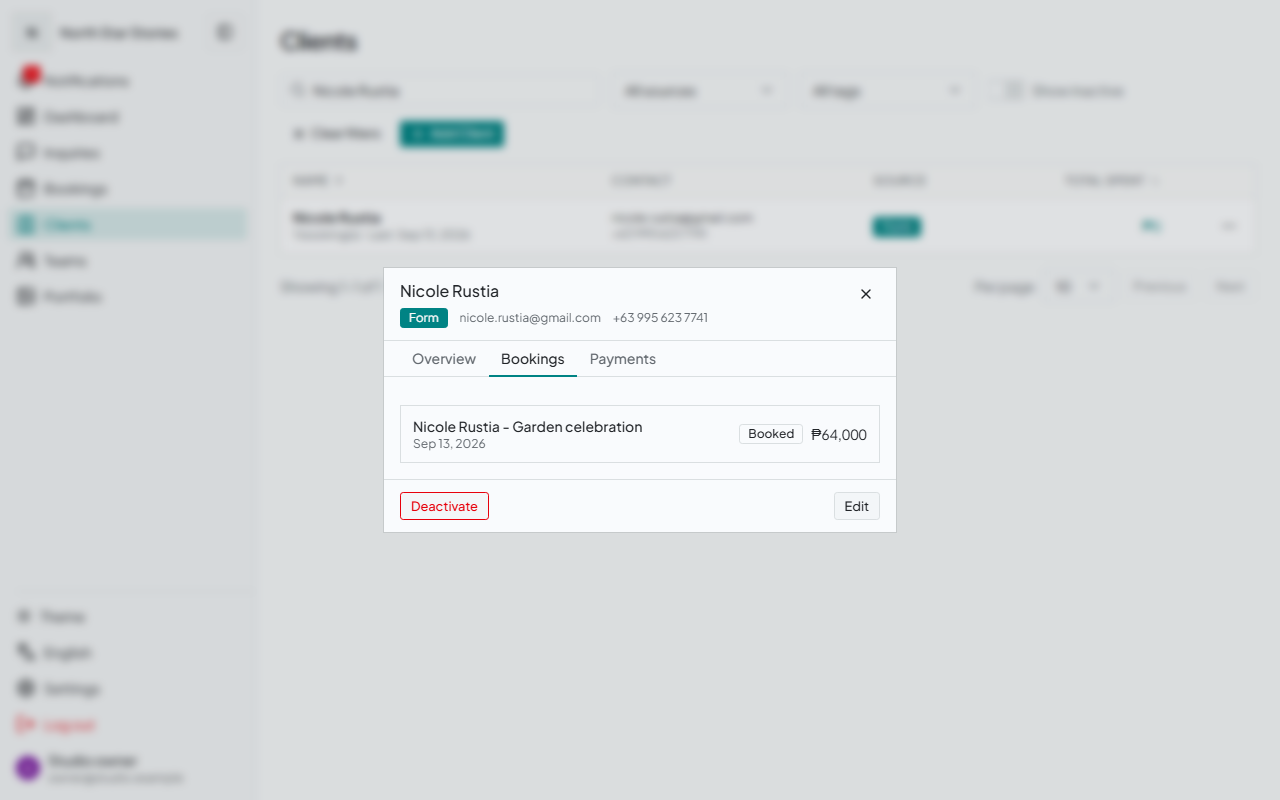
- The inquiry, the client record and the booking are created together.
- It appears in your inbox inside the app and on your calendar.
- You reply.
Price
| Gallurio | Google Forms + Gmail + Sheets | |
|---|---|---|
| Cost | $15.00/mo | Free |
| Enquiry lands as | A client and a booking | A spreadsheet row and an email |
| Manual transcription | None | Every enquiry |
| Public page | Portfolio with home, gallery, contact | Whatever you already have |
| Client history | Automatic | However you maintain it |
| Partial failures | Impossible — one transaction | A row without a reply, an email without a row |
What the free stack does that Gallurio does not
- It costs nothing.
- Custom questions, any shape. Google Forms has conditional logic, file uploads, any field you want. Gallurio's contact form is fixed.
- It plugs into everything — Sheets, Apps Script, Zapier, whatever you have already wired.
- Everyone knows how it works, including whoever covers for you.
If your enquiry form asks fifteen conditional questions, Google Forms is genuinely better at that part and Gallurio does not try to compete with it.
What Gallurio does that the free stack does not
- One transaction, no transcription. The single largest difference.
- A configurable creative storefront — independent Home and Gallery canvases for story, services, video, featured projects, grid or masonry galleries, and project collections — instead of a bare form.
- A calendar of real bookings with statuses and deposits.
- Invoice PDFs generated from the booking.
- Client history, kept without maintenance.
- Team access with roles, rather than a shared login and a shared sheet.
Discovery before the form submission
Google Forms solves intake after someone receives the link. It does not create the public evidence that helps a new client find and trust the business. Gallurio puts the form behind configurable Home and Gallery pages where the owner can explain services, name the locations served, and prove the work through real projects.
Published portfolios support configurable search titles and descriptions, canonical URLs, social previews, structured business/gallery data, and an indexing choice. This gives crawlers and AI retrieval systems useful context before the inquiry happens. It does not guarantee visibility; the portfolio still needs specific, credible content and links from places potential clients already use.
Who this is not for
Stay with the free stack if:
- Your enquiry form needs conditional logic or file uploads.
- You get few enough enquiries that none get lost.
- You have already automated the handoff with Apps Script or Zapier and it works.
- You are the only person involved and the inbox is genuinely under control.
Related comparisons
- Gallurio vs Google Sheets — the record-keeping half
- Gallurio vs Squarespace — if the form sits on a built site
- Gallurio vs HoneyBook — the paid end of the same problem
Sources
Google Forms, Gmail, and Google Sheets are available with a Google account. Google Workspace also offers paid business plans. Verified from Google's first-party product and pricing pages on 2026-08-23.
Frequently asked questions
What is actually wrong with using a Google Form for enquiries?
Nothing about the form. The problem is everything after it — the response lands in a spreadsheet row and an email, and a human has to copy it into wherever bookings really live. That copy step is where enquiries get lost.
Does Gallurio replace my contact form?
Yes. Every Gallurio workspace publishes a portfolio with a contact form. A submission creates the inquiry, the client record and the booking together, so there is nothing to transcribe.
Is the free stack really costing me anything?
Only in enquiries you answer late or not at all, and in the hour a week spent moving data between tools. Whether Gallurio's current regional price is worth it is a question about your volume, not about software.
Can I keep my existing website and still use Gallurio?
Yes. Link your existing site's enquiry button to your published Gallurio portfolio, where Contact opens, and the rest of the flow works unchanged. The portfolio can be the main site or the connected inquiry destination.
Can Gallurio help potential clients discover my business before they inquire?
Yes, through server-rendered Home and Gallery pages with configurable search descriptions, canonical URLs, social previews, structured business/gallery data, and indexing controls. These are discovery foundations, not guaranteed rankings.