
Guide
Website builder or booking system: which do you need?
Compare a creative website builder with a booking system, including portfolio SEO, galleries, inquiries, client records, calendars, deposits, and invoices.
The question sounds like a choice between two categories of tool. In practice most event businesses need what each one does, just not from the same product — and knowing which is which saves a lot of wasted evaluation time.
Do you need a website builder or a booking system?
Probably both, doing different jobs. A website builder's job is to express the brand, show its skills, services, and strongest projects, and give a visitor enough confidence to make contact. A booking system's job is to turn "yes, I want to book" into a tracked client, a booking, a deposit, and a timeline that doesn't live in your head. Neither one substitutes for the other — a beautiful site with no booking record behind it, or a solid booking system with no public page to send enquiries to, both leave a gap.
What does a website builder actually solve?
Getting found and making the work persuasive. This is SEO, page speed, a gallery that looks good on a phone, clear services and positioning, project collections that reveal the depth of the work, and a visual system that feels like the creator's own brand. Builders like Squarespace and Wix are genuinely good at this — polished themes, drag-and-drop editing, a low barrier to a page that looks professional. What they are not built for is what happens after someone fills in a contact form: that submission usually just becomes an email, with nothing tracking it from there.
What SEO foundation does a creative portfolio need?
Start with the basics that help both people and crawlers understand the business:
- A specific search title and summary for the Home page
- A distinct Gallery description rather than duplicated Home copy
- One stable canonical URL for each public page
- Crawlable headings and service copy that name the work and location naturally
- Fast, mobile-friendly image delivery and meaningful descriptions for important images
- Structured business and gallery information where the data is accurate
- A deliberate indexing control for pages that should stay out of search
These are foundations, not promises. Google's current AI search guidance says there is no special markup that automatically puts a site first, and its AI search features use the same core search and quality systems. The page still needs useful, original work and enough context for a potential client to understand why it is relevant.
What does a booking system actually solve?
Everything after "yes." Once someone wants to book, a booking system holds the client record, the booking details, what's been paid against what's owed, the event timeline, and the calendar so two enquiries can't land on the same date without anyone noticing. A page builder generally has none of this — it was never built to.
Why do most event businesses end up wanting both?
Because the two problems don't overlap. A site builder with no booking layer means every enquiry becomes a manual chase through email and spreadsheets. A booking system with no public-facing page means there's nowhere for a new client to find you and see your work in the first place. Businesses that start with only one eventually feel the gap left by the other — the site looks great but bookings are chaos, or bookings run smoothly but there's no page to send people to.
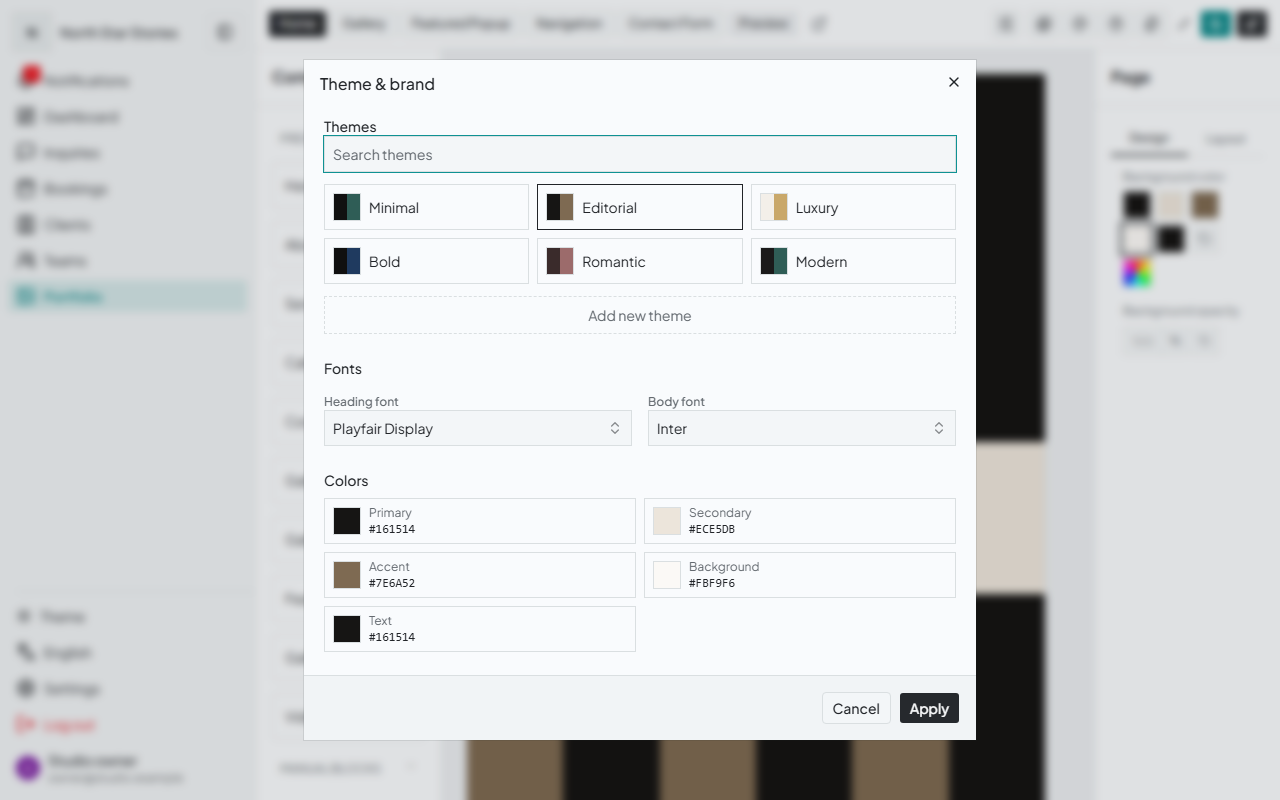
Gallurio covers both sides because that gap is common. Its public portfolio is not merely a contact page attached to the CRM. Home and Gallery are independent drag-and-drop canvases where a creative business can combine its story, services, video, calls to action, individual images, featured projects, grid or masonry galleries, and project collections. Layout composition, spacing, colours, typography, imagery, and controls turn those two pages into the storefront for the business - in the presentation sense, not an ecommerce checkout.
The published pages are server-rendered and expose configurable search titles and descriptions, canonical URLs, social preview settings, and structured business/gallery data. That makes the portfolio technically understandable to search engines and AI retrieval systems while leaving the owner responsible for the specific services, locations, project evidence, and copy that deserve to be discovered.
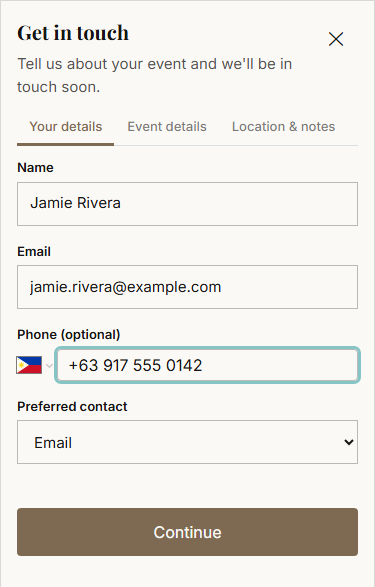
The same portfolio then creates the inquiry, client, and booking record in one step, with no email hand-off in between, at $15.00/mo — $150/yr. Running a broader page builder alongside a separate booking tool is also legitimate when the business needs blogs, ecommerce, memberships, or more page types; the important part is that the public and operational sides are genuinely connected.
How do you decide what to get first?
Whichever gap is costing you more right now. If you have no public page and rely on referrals and social media, getting found is the bottleneck — start there. If you already get enquiries but they fall through the cracks between an inbox and a notebook, the booking side is what's actually leaking revenue, and a nicer website won't fix that.
What most people get wrong
- Assuming a page builder's contact form is a booking system. It sends an email. Nothing after that is tracked unless you track it yourself.
- Buying a full booking platform before there's a page sending it enquiries. The best booking system has nothing to do if nobody can find you.
- Running both without connecting them. A public page and a separate booking tool that don't talk to each other just move the manual copy-paste step, not remove it.
- Picking based on which one has the nicer templates. Templates are the easy part to fix later; a missing booking record is the part that costs actual bookings.
Related reading
- Gallurio vs Squarespace — where a page builder's strengths stop
- Gallurio vs Wix — the same trade-off against Wix
- Gallurio vs Pixieset — a gallery-first tool built for delivery rather than booking
- Writing a portfolio page that books clients — what the public page side needs to do well