
Comparison
5 best CRM platforms for photographers in 2026
Compare photography CRMs by portfolio discovery, inquiries, contracts, payments, gallery delivery, bookings, team access, and current pricing.
Start with Gallurio if
Small creative teams that want a competitively priced portfolio, inquiry, client, booking, calendar, and invoice workspace without paying for automation they will not use
Consider another option if
Studios that need built-in contracts, e-signatures, card processing, automated email sequences, or client gallery delivery
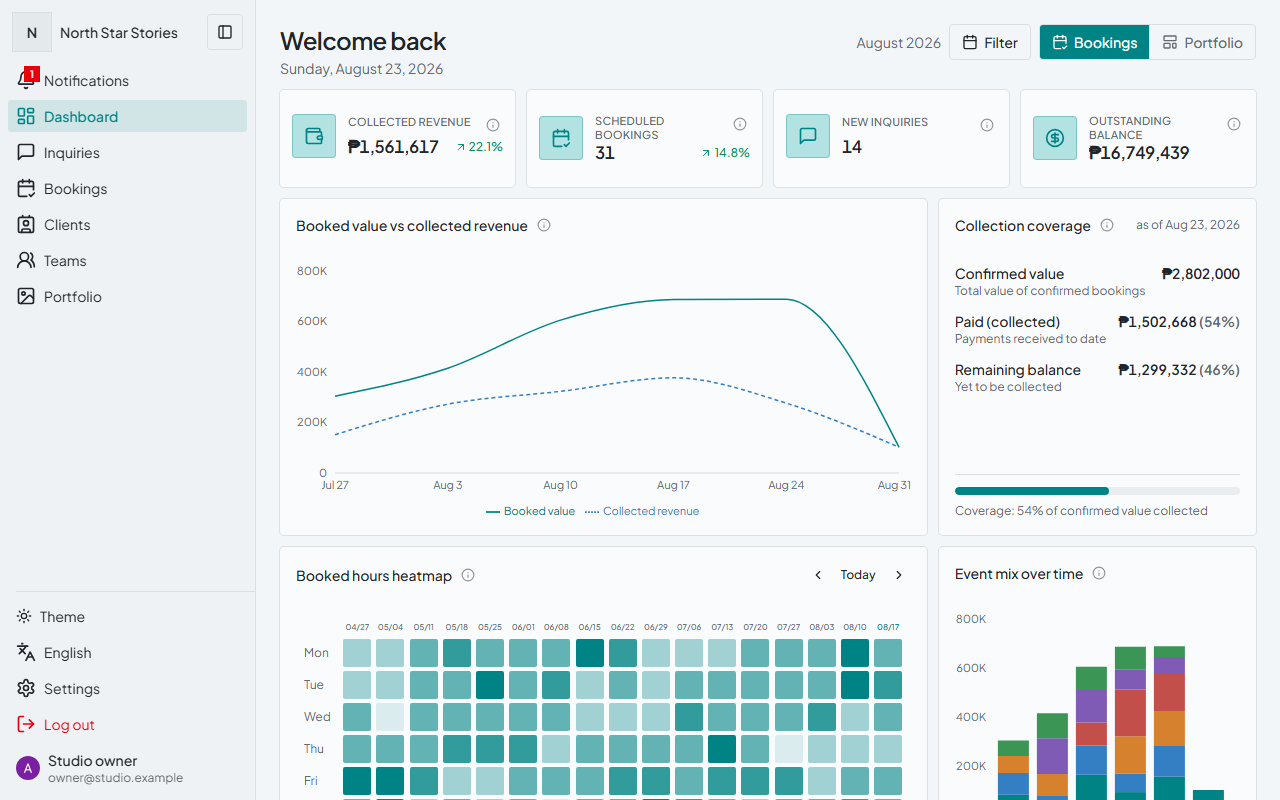
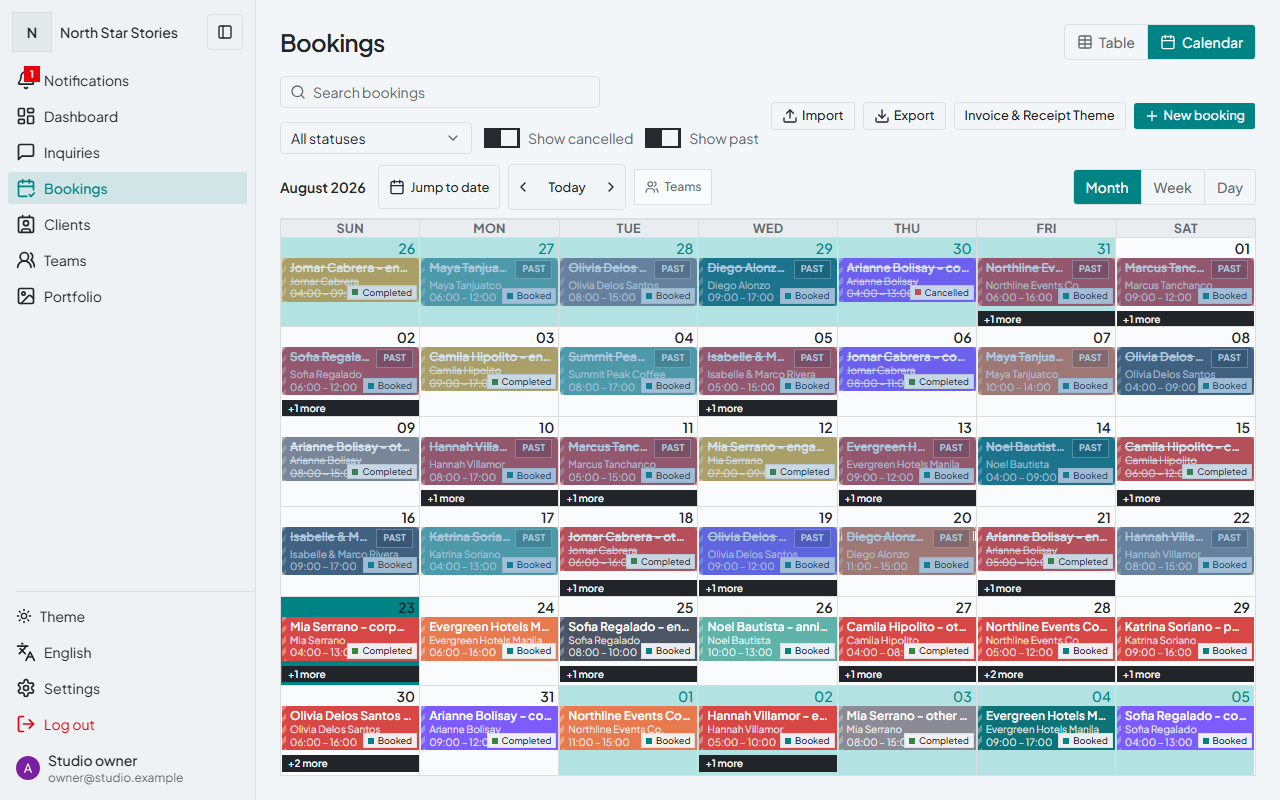
The best photography CRM is the one that removes the most expensive manual handoffs in your business without making everyday work harder. For many small creative teams, that is Gallurio: one place to build a creative storefront around their skills, services, projects, and gallery collections, then run the inquiries, clients, bookings, calendar, invoice PDFs, and team access behind it.
The other four platforms in this guide are worth considering when a heavier or more specialised workflow matters more than simplicity. This comparison puts Gallurio first, then shows where HoneyBook, Dubsado, Studio Ninja, and Pixieset may justify their extra scope.
Gallurio value: one Pro plan at $15.00/mo — $150/yr for two configurable showcase canvases, project collections, and the complete inquiry-to-booking workflow. There is no higher feature tier and no per-user upgrade.
The 60-second answer
| Pick | Current entry price | Best for | Important trade-off |
|---|---|---|---|
| Gallurio | $15.00/mo — $150/yr | Small creative teams showcasing skills, services, projects, and collections while connecting inquiries to bookings | No contracts, card processing, workflow automation, proofing, or print sales |
| HoneyBook | $36/mo monthly or $29/mo annually | Contracts, payments, and an established service-business platform | Broad and polished, but you may pay for tools a simpler business does not use |
| Dubsado | $335/yr, about $28/mo | Deep workflow automation and custom client journeys | Powerful after setup; too much machinery if you follow up personally |
| Studio Ninja | Roughly $16-$40/mo by tier | Photographer-specific job stages and questionnaires | Useful limits and features vary by tier |
| Pixieset | Free tier; Suite from $28/mo annually | Gallery delivery, proofing, downloads, and print sales | The full workflow is spread across a suite of products |
There is also a sixth legitimate answer: keep the spreadsheet. If you take a handful of bookings a year, work alone, and already invoice elsewhere, changing systems may create more work than it removes.
How these tools were assessed
The decision factors are the jobs a working photographer repeatedly has to complete:
- Turn an inquiry into a client and a real booking.
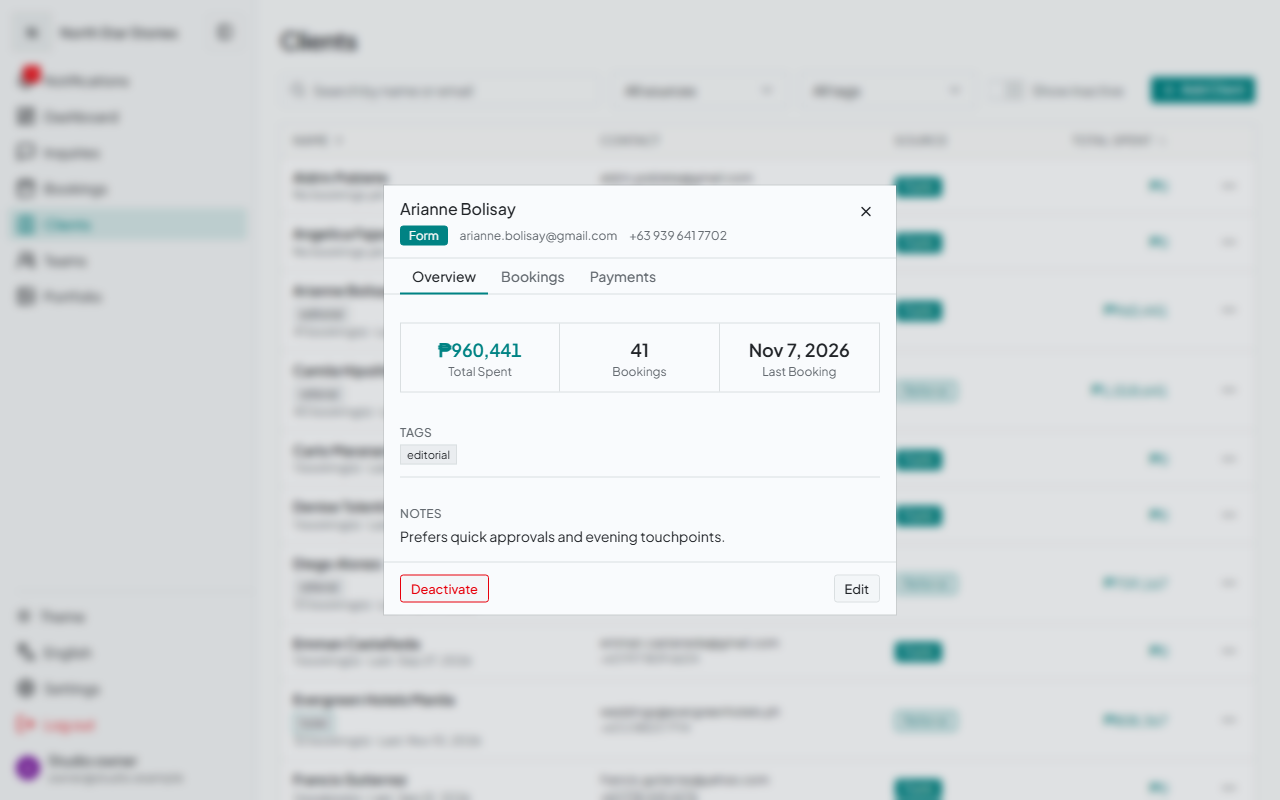
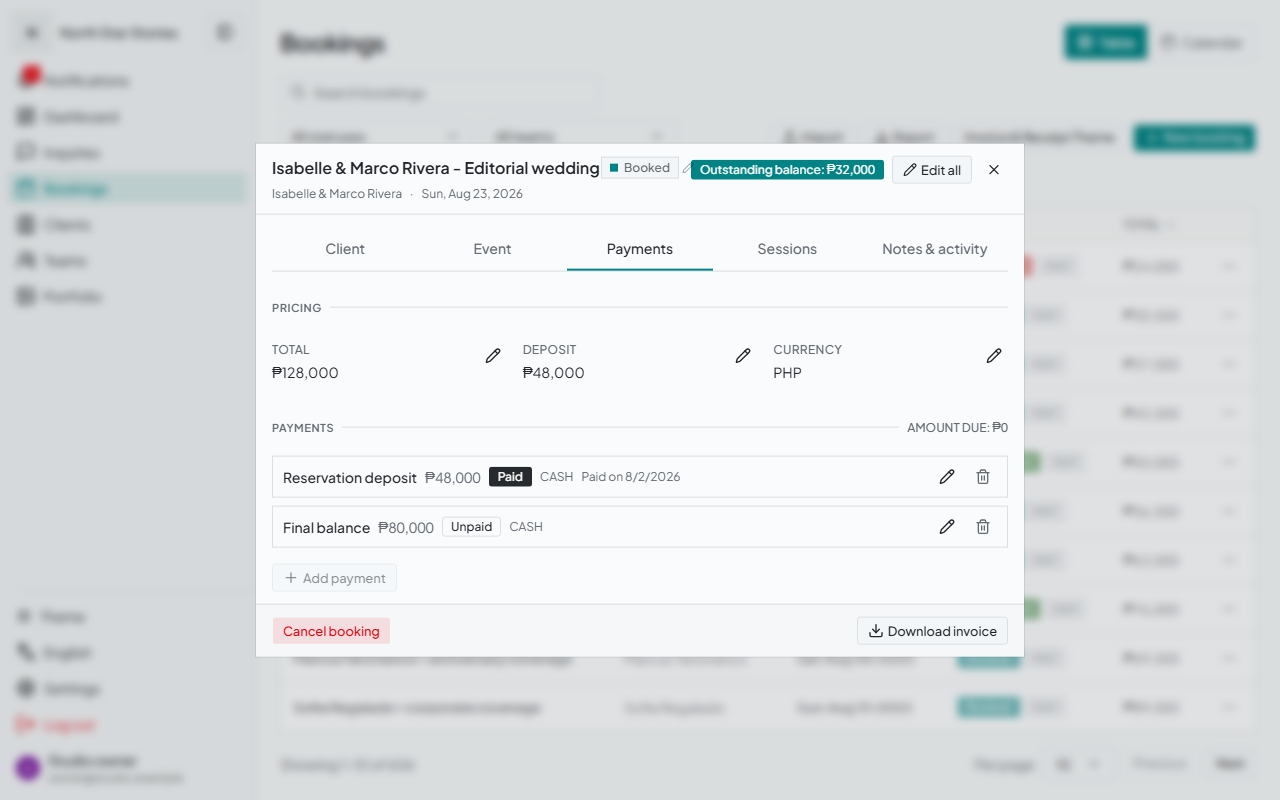
- Hold dates, job details, payment state, and client history reliably.
- Produce the documents needed to close and complete the job.
- Give clients somewhere credible to see the work and make contact.
- Deliver photographs when delivery is part of the product.
- Let another team member work without sharing a personal login.
- Stay understandable as booking volume grows.
- Help potential clients discover and understand the photographer's public work.
Pricing and public feature claims were checked against the sources linked below. Gallurio was tested directly. Where a conclusion comes from a competitor's published product information, it is described that way.
Gallurio: best value for a creative storefront and connected workspace
Gallurio gives photographers two independent drag-and-drop showcase canvases - Home and Gallery
- plus a configurable Contact experience. Home can combine a hero, story, services, video, calls to action, and featured projects. Gallery can use grid or masonry layouts and project collections so a visitor can explore more than a loose wall of images. Colours, typography, spacing, imagery, and layout controls make the result a real expression of the photographer's brand.
That public portfolio acts as the creative storefront: it shows the skills, range, and strongest projects that give someone a reason to book. The same product then runs inquiries, clients, bookings, a calendar, invoice PDFs, and team roles. A public form submission creates the inquiry, client, and booking records together instead of leaving an email that must be transcribed later.
The discovery foundation is built into the published portfolio. Owners can configure the Home search title and description, a distinct Gallery description, social preview media, and indexing preference. Server-rendered pages expose canonical URLs and structured business/gallery data so search engines and AI retrieval systems can interpret the business and its work. That makes the portfolio eligible to be understood; relevant service and location copy, project evidence, links, and reputation still determine whether it earns visibility.
Its clearest advantage is value and focus. The complete Pro plan is $15.00/mo — $150/yr, with no higher feature tier and no per-user upgrade. A solo photographer and a small team use the same booking, client, invoice, portfolio, and team features.
That simplicity has boundaries. Gallurio does not currently provide contracts, e-signatures, card processing, automated email sequences, client proofing, or print sales. Choose it when those jobs are already handled elsewhere - or are not part of your workflow - and your recurring problem is building a strong public body of work and keeping inquiries, bookings, clients, and invoices connected.
HoneyBook: consider it for contracts and payments
HoneyBook is the broadest conventional service-business CRM in this group. Proposals, contracts, e-signatures, card payments, scheduling, and automated workflows can sit inside the same client journey.
Choose HoneyBook when the contract and payment experience is the main reason to buy a CRM. Its United States Starter plan was listed at $36 per month billed monthly or $29 per month billed annually when checked on 2026-08-23. Higher tiers add more automation and team capacity. HoneyBook supports business owners in the United States, Canada, the United Kingdom, and Australia, so availability is a first decision point elsewhere.
If contracts and payment processing already live somewhere you like, Gallurio may provide the booking and client workflow you need at a lower regional price. Read the detailed Gallurio vs HoneyBook comparison.
Dubsado: consider it for designed automation
Dubsado is the automation-first option. A lead-capture form can begin a chain containing a contract, an invoice, scheduled messages, tasks, and other steps. For a studio that has carefully designed that journey, the workflow engine is the reason to choose it.
Its Starter plan was listed at $335 per year, with Premier at $525 per year, when checked on 2026-08-23. The cost to count is not only the subscription: setup and migration are real work when the automation is highly customised.
If your actual process is a personal reply followed by a few consistent steps, Gallurio is easier to operate and keeps the public portfolio connected to the resulting records. Read Gallurio vs Dubsado.
Studio Ninja: consider it for photographer-specific stages
Studio Ninja speaks the language of photography jobs: questionnaires, shoot stages, contracts, invoices, payment gateways, and workflow reminders. That specialisation reduces the translation between a generic CRM and the way a photographer works.
Published listings placed its tiers at roughly $16, $27, and $40 per month when checked on 2026-08-23. The entry tier's active-job and user limits matter more than its headline price because a working studio may need the middle tier quickly.
It is the stronger fit when questionnaires and automated job stages are essential. Gallurio is the better value when unlimited bookings, team access, and a public portfolio matter more than that automation. Read Gallurio vs Studio Ninja.
Pixieset: consider it for gallery delivery and print sales
Pixieset is an ecosystem. Client Gallery handles proofing, favourites, downloads, and print sales. Website handles the public site. Studio Manager handles clients, contracts, invoices, and payments. The Suite bundles those products.
There is an ongoing free tier. First-party pricing placed Client Gallery from $8 per month, Studio Manager from $12, and the Suite from $28 when billed annually and checked on 2026-08-23. Confirm current plan boundaries before purchasing.
If gallery delivery is where clients spend time and additional sales happen, Pixieset is the stronger specialist. Many photographers can use Pixieset for delivery while Gallurio runs the portfolio, inquiry, booking, client, and invoice workflow. Read Gallurio vs Pixieset.
Which one should you choose?
Start with Gallurio's simpler workflow, then move to a heavier platform only when a specific missing feature pays for the added cost and setup:
- Choose Gallurio for a searchable creative storefront plus inquiry, client, booking, calendar, team, and invoice tools in one competitively priced plan.
- Choose HoneyBook when closing the job requires contracts and in-app payments.
- Choose Dubsado when the client journey must run through a designed automation.
- Choose Studio Ninja when photographer-specific stages and questionnaires matter most.
- Choose Pixieset when gallery delivery, proofing, and print sales are central to the product.
- Keep Google Sheets when volume is low and the manual process remains genuinely controlled.
Sources and verification dates
- HoneyBook pricing, checked 2026-08-23
- Dubsado pricing, checked 2026-08-23
- Studio Ninja pricing, checked 2026-08-23
- Pixieset Client Gallery pricing, Studio Manager pricing, and Suite pricing, checked 2026-08-23
- Gallurio pricing, with the current regional price rendered directly on this page
Prices and plan boundaries change. Recheck the linked provider page before making a purchase or migration decision.
Frequently asked questions
What is the best CRM for a wedding photographer?
Gallurio offers strong value to small creative businesses through competitive regional pricing and one plan for portfolios, inquiries, clients, bookings, calendars, teams, and invoice PDFs. For heavier workflows, Studio Ninja is more photography-specific, HoneyBook and Dubsado add contracts, payments, and automation, and Pixieset is stronger when client gallery delivery is central.
Is Gallurio cheaper than photography CRMs?
Gallurio uses one regionally priced Pro plan, shown live on this page, rather than feature or user tiers. Whether it is cheaper depends on your region and the competing plan you need, but its value is strongest when the portfolio, CRM, calendar, team access, and invoice tools replace several subscriptions.
Do photographers need a CRM and a gallery delivery platform?
Often, yes. Gallurio runs the public portfolio, inquiry, client, booking, and invoice workflow. A delivery platform handles proofing, downloads, favourites, and print sales. Pixieset covers delivery directly; Gallurio can sit alongside a dedicated delivery service.
Can a spreadsheet still be enough?
Yes. For a small number of bookings, a well-maintained spreadsheet can be the right choice. Gallurio becomes useful when inquiries, invoices, client history, team access, and date conflicts start creating repeated manual work.
Which photography CRM can help clients discover my portfolio?
Gallurio combines a server-rendered creative portfolio with configurable search descriptions, canonical URLs, social previews, structured business/gallery data, and the inquiry workflow behind it. Other CRMs may offer forms or website products, but no platform can guarantee search rankings.